How to Run an AI Visibility Audit on Your Own Website

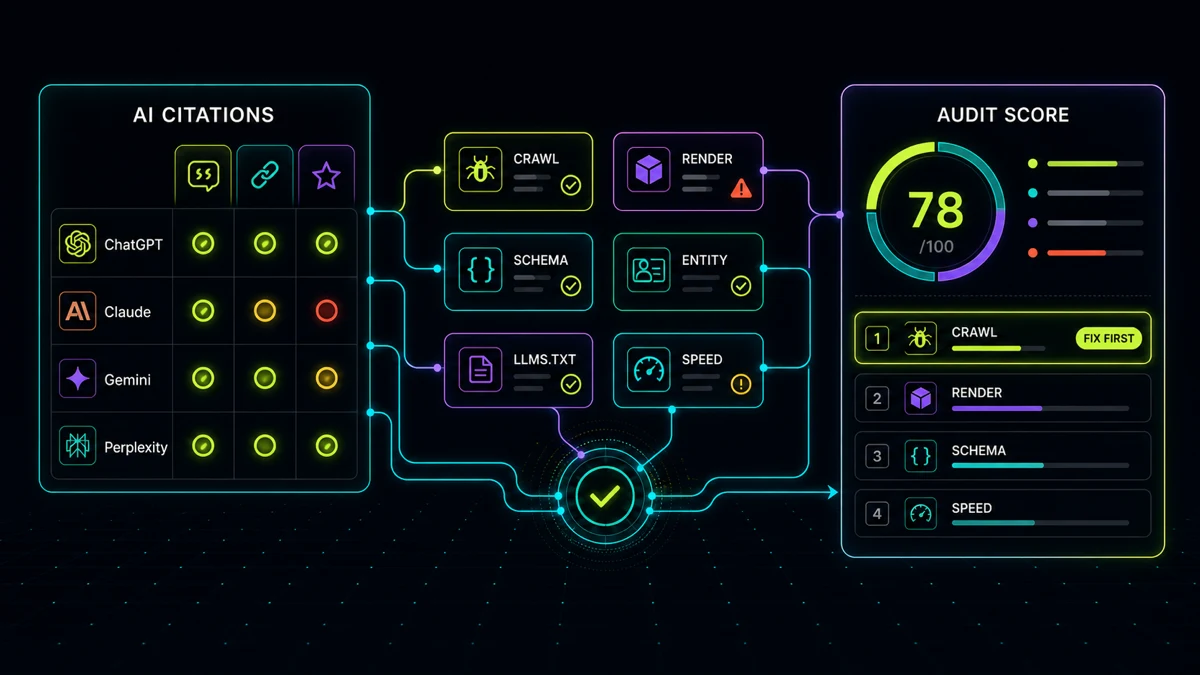
An AI visibility audit answers two questions about your website. Can AI engines read it? And when a buyer asks ChatGPT, Claude, Gemini, or Perplexity for a business like yours, do they name you? Most guides to auditing AI visibility are written for brands with a marketing team and a tracking subscription. This one is for a service business owner with an hour and no budget. Every step uses a free tool, and by the end you will have a scorecard that tells you what to fix first.
The order matters. Whether AI names you is the outcome you care about, so that check comes first. But the reasons it does or does not name you are technical, and those checks are where the fixes live. Run both halves, then read them together.
What an AI visibility audit measures (and what it does not)
A traditional SEO audit scores rankings and on-page factors. An AI visibility audit measures something different: whether answer engines can find, understand, verify, and cite your business. Google’s own guidance on AI features and your website says there are no special technical requirements beyond being indexable and eligible for a snippet, and that is true as far as it goes. The catch is that indexable has to hold for the AI crawlers too, and being eligible is not the same as being chosen. The audit is how you find out which side of that line you are on. If the vocabulary is new, answer engine optimization is the work this audit measures.
Part 1: Do AI engines name you?
Start with the outcome. Write down three to five questions a real buyer would ask, in the words they would use: “best [your service] in [your city],” “who should I call to [solve the problem you solve],” “[your service] near me that handles [specialty].” Then ask each one in ChatGPT with search on, in Claude, in Gemini, and in Perplexity. Google’s AI Overviews are built on Gemini, so a Gemini answer with search grounding is a fair proxy for what the Overview will pull.
For each answer, record three things: whether you were named, whether your site was cited as a source, and which competitors were named instead. That last column is the most useful one in the whole audit, because the businesses AI trusts more than yours are the benchmark for everything in Part 2.
Doing this by hand across four engines and five questions is twenty prompts. The AI Visibility Check runs your headline query across ChatGPT, Claude, and Gemini at once and shows the citation grid cell by cell. Either way, the result is a baseline. If AI already names you, the job is to hold and widen the lead. If it names your category but not you, the demand exists and someone else is capturing it. Our guides to how to show up in ChatGPT and how to get cited by AI cover what to do with each outcome.
Part 2: Can AI engines read you?
This is the half most audits skip, and it is where the fixes are. Six checks, each with a free tool.
1. Crawler access. AI engines run their own crawlers, and a robots.txt rule written years ago can block them without anyone noticing. OpenAI documents GPTBot and OAI-SearchBot, Anthropic documents ClaudeBot, and Perplexity documents PerplexityBot. Paste your domain into the robots.txt analyzer and it reports which of those crawlers you allow, which you block, and which you have never addressed.
2. Rendering. If your pages build their content in the browser with JavaScript, a crawler that does not execute scripts receives a shell with your services, copy, and proof missing. The quick test is to view the page source (not the inspector) and search for a sentence from your homepage. If it is not in the raw HTML, AI is not reading it. Why ChatGPT can’t see your website walks through what that looks like and the fix.
3. Structured data. Schema markup states your business facts in a format machines parse without guessing. Google’s introduction to structured data explains how it is used, and the five schema types every service business should have covers which ones matter. Check what you have with Google’s Rich Results Test, then generate what is missing with the schema generator.
4. Entity signals. AI engines cite businesses they can recognize as a specific, consistent entity. That comes from Organization schema with sameAs links to your real profiles, plus the same name, address, and phone everywhere you appear. The entity check scores those signals and generates the Organization block, and entity SEO for small businesses explains why it matters.
5. llms.txt. A plain-text file that tells AI systems what your site is and where the important pages are. Not every engine reads it yet, but it costs five minutes, and the llms.txt generator writes it from your sitemap. llms.txt and robots.txt for AI covers how the two files work together.
6. Speed. Google’s AI features draw from the same index as Search, and page experience still counts there. Run your homepage through the PageSpeed calculator on mobile, and if the Core Web Vitals are failing, the mobile Core Web Vitals guide shows which fix comes first.
Part 3: What AI gets wrong about you
A business can be named and still lose the customer if the answer lists the wrong phone number or says you are closed on Saturdays. Go back to the Part 1 transcripts and check every fact an engine stated about your business: hours, phone, address, services, service area. Each mistake traces back to an inconsistent source somewhere on the web, usually a directory listing or an old profile. Fix the source and the answers follow.
Build the scorecard and pick the first fix
Put the results in one table: five buyer questions down the side, four engines across the top, and a named, cited, or competitor entry in each cell. Under it, list the six technical checks as pass or fail. Then prioritize in this order: crawler access and rendering first, because nothing downstream matters if AI cannot read the page; structured data and entity signals second, because they are what turn a readable page into a citable business; llms.txt and speed last. The generative engine optimization checklist breaks these into fourteen five-minute checks if you want a finer grid.
Date the scorecard. AI answers change, and an audit is a measurement, not a permanent state. Rerun Part 1 monthly and Part 2 after any site change. How to monitor your AI visibility covers the cadence.
When the free tools are enough, and when they are not
For most small service businesses, the audit above is the whole job. You will find one or two blocking issues, fix them, and start showing up. Where the manual version runs short is scale and comparison: running the citation matrix across every buyer question, checking every page for schema instead of just the homepage, and seeing the same checks on the three competitors AI named instead of you. Josh uses the full AI visibility audit to investigate those gaps when there’s a fit for implementation work. The free score at the top of that page gives you an initial view of where you stand.