How to Get Cited by AI: What Answer Engines Look For in a Source

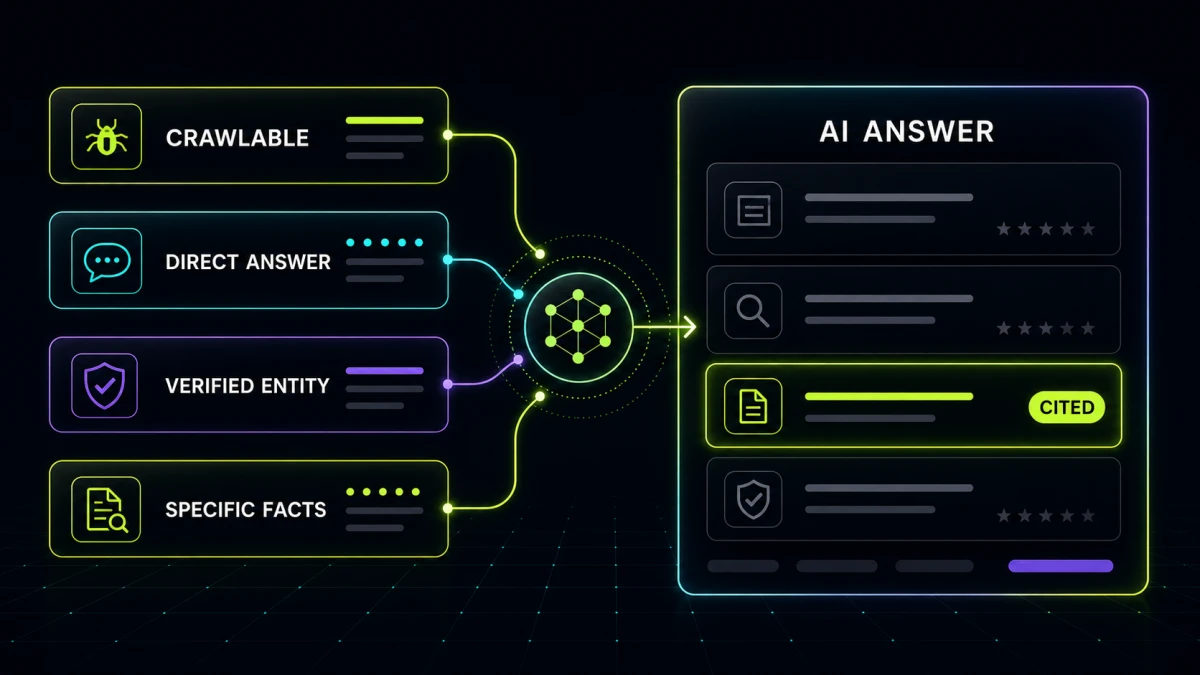
Getting cited by AI means an engine like ChatGPT, Perplexity, Gemini, or Google’s AI Overviews uses your website as a source when it composes an answer: it names your business in the response, links your page in the sources panel, or both. There’s no slot to buy and no form to submit. Engines cite pages they can read, answers they can lift, and businesses they can verify, which makes citation an earned result with concrete requirements.
Four requirements, in practice. Your content has to be readable by AI crawlers, which means server-rendered HTML and no accidental blocking rules. It has to answer a real question directly enough that an engine can quote it. Your business has to be verifiable through structured data and consistent mentions beyond your own site. And the facts you want repeated have to actually be on the page, stated as specifics rather than adjectives. This guide walks through each requirement, how the major engines differ in what they cite, and how to find out whether you’re being cited right now.
What “cited by AI” actually means
A citation shows up in two places, and they matter differently. The first is the answer itself: “For commercial HVAC maintenance contracts, companies like X and Y are frequently recommended.” Being named in the sentence is the highest-value outcome, because most readers never open a source list. The second is the sources panel: your page linked as one of the references behind the answer. That’s still a click path and a trust signal, and it’s usually the first rung. Pages that get linked as sources repeatedly are the ones engines eventually feel confident naming.
Both outcomes are downstream of the same mechanics. When an engine with live search handles a question, it retrieves a set of pages, reads them, and composes an answer from the ones that actually address the question. Your job is to be in that retrieved set and to be the easiest page in it to quote.
Requirement 1: AI crawlers can read your page
Every citation starts with a successful crawl, and this is where most sites fail before anything else gets evaluated. Most AI crawlers read raw HTML and don’t execute JavaScript, so a client-rendered page can look complete to a human and nearly empty to the crawler. We cover the mechanics and the fixes in why ChatGPT can’t see your website. The second failure mode is permissions: OpenAI’s crawlers, ClaudeBot, PerplexityBot, and Google-Extended all obey robots.txt, and an old catch-all rule can turn them away silently. Our robots.txt Analyzer shows exactly which AI crawlers your file admits, and our guide to llms.txt and robots.txt covers how to point the ones you admit at your important pages.
Requirement 2: There’s an answer worth lifting
Engines cite pages that answer the question, not pages that are about the topic. That’s a content-shape problem, and it has three parts. Lead with the answer: the opening of a page should state what you do, for whom, and where, because engines weight openings heavily when they decide what to quote. Write headers as questions buyers actually ask: “How much does a commercial HVAC maintenance contract cost?” hands an engine a labeled answer to lift, while “Our Commitment to Excellence” hands it nothing. And favor specifics over adjectives: “licensed and bonded, serving the Midwest since 2009, 24-hour response on service calls” is quotable, while “trusted and professional” is not. An engine can repeat a fact; it can’t repeat a mood.
Requirement 3: Your business is verifiable
Before an engine names a business, it needs confidence that the business is a real, coherent thing. Two signal groups build that confidence. On your site, Schema.org structured data (Organization with real sameAs links, LocalBusiness, Service, FAQPage) states your name, services, and area in a format built for machines. The five schema types every service business should have walks through each with paste-ready JSON-LD, and our Schema Generator builds the blocks for you. Off your site, consistent mentions in directories, review platforms, and trade and local press corroborate the same facts. The two reinforce each other: clear markup plus matching third-party mentions is what lets an engine treat you as a known entity, and the Entity & Knowledge Graph Check shows how well-defined your entity is today.
Do ChatGPT, Perplexity, and Gemini cite differently?
At the margins, yes. Perplexity is citation-first and displays its source list prominently, so clear structure and corroboration pay off fastest there. ChatGPT synthesizes more and names sources more selectively. Gemini and Google’s AI Overviews draw on Google’s index and systems, and Google’s own guidance on its AI features is explicit that there’s no special AI markup: the same access, quality, and structured-data fundamentals apply. That’s the practical takeaway across all of them. The retrieval layers differ; the requirements above don’t. Do the foundational work once and it compounds across every surface, which is the same conclusion we reached comparing AEO, GEO, and SEO as disciplines.
How to check whether AI cites you today
Ask the engines what a buyer would ask: “best [your service] in [your market],” “who should I hire for [problem].” Note who gets named and whose pages appear as sources, because those are the businesses currently clearing the four requirements in your market. How to show up in ChatGPT covers the query patterns that reveal citation behavior on one engine, and our AI Visibility Check runs buyer-intent prompts across ChatGPT, Claude, and Gemini in one pass and shows you who got cited where.
What to fix first
Work the requirements in order, because each one gates the next: readability first, then answer shape, then verification. If you want the full inspection list, the generative engine optimization checklist breaks these into fourteen five-minute checks. For an initial overview of your own site, start with the free AI visibility score. If you want help implementing the findings, Josh reviews your free AI visibility score with you by email and uses a full audit to scope the work once there’s a fit.