Entity SEO: How to Become an Entity AI Engines Can Recognize

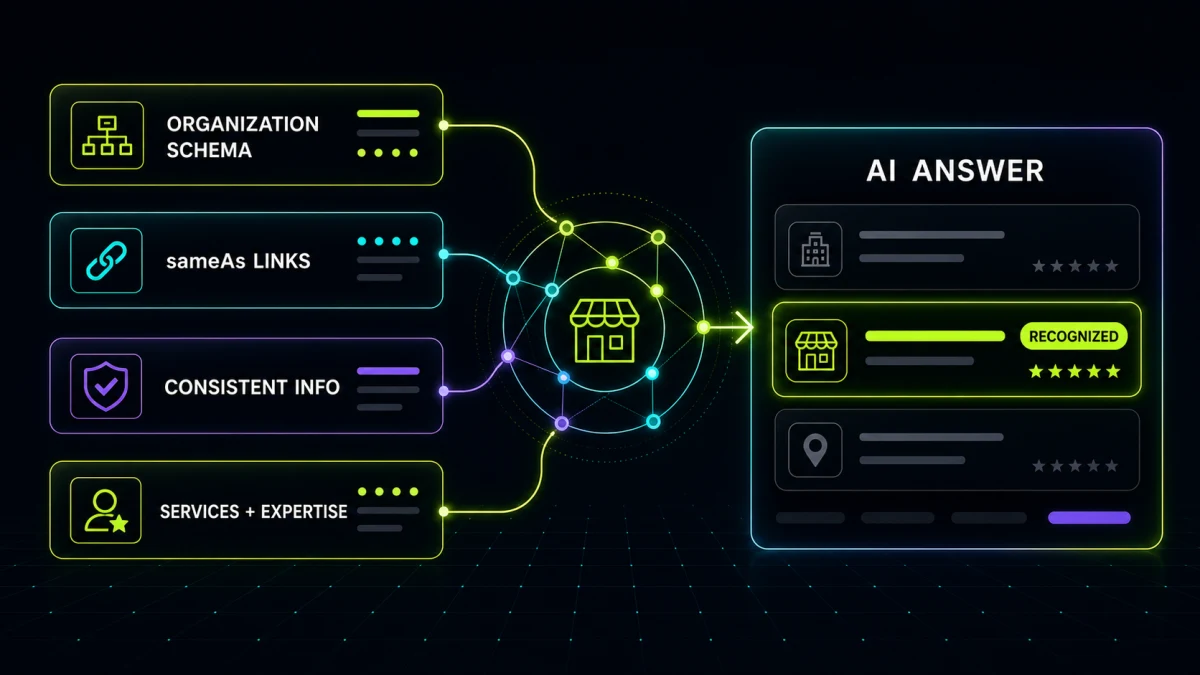
Entity SEO is the work of making your business a clearly defined thing that search engines and AI engines can recognize, trust, and cite, not just a website that contains the right keywords. Google has reasoned about entities for over a decade: its Knowledge Graph models people, organizations, and places, plus the relationships between them. AI answer engines push the same idea further. When ChatGPT or Gemini answers “who should we hire for a commercial HVAC retrofit,” it is not ranking ten blue links. It is deciding which specific businesses it can confidently name, and that confidence comes from how clearly each business is defined across the web.
For most businesses, this is better news than most SEO trends. Entity work does not require a big content budget or years of accumulated domain authority. It requires stating who you are, what you do, and where you do it in a machine-readable, consistent way. Most competitors have not done that work. This guide covers what an entity actually is, why AI search raises the stakes, the four signals that define your entity, and how to check how well-defined yours is today.
What an entity is (and how it differs from a keyword)
A keyword is a string of text. An entity is the thing the text refers to. “Employment attorney” is a keyword. A specific firm with a name, an address, a bar registration, and a history of client reviews is an entity. Classic SEO spent twenty years matching strings: put the words on the page that the searcher types in the box. Entity-based search matches things: understand what this organization is, what services it provides, where it operates, and how it connects to other known things.
The distinction matters because a machine can only recommend what it can identify. If your homepage headline says “trusted partners in workplace success,” a human might infer an HR consultancy. A machine sees adjectives. Nothing on that page tells an engine what category you belong to, which markets you serve, or whether you are the same company that appears in a directory listing under a slightly different name. A business that cannot be pinned down does not get named.
Why AI search raises the stakes
Traditional search results could stay vague. A results page can rank a poorly defined site at position four and let the searcher sort it out. An AI answer cannot hedge that way. Naming a business inside a sentence reads as a recommendation, so engines reserve it for businesses they can verify. Verification is one of the four requirements covered in how to get cited by AI: engines cross-check what your site claims against structured data and against what the rest of the web says about you. The clearer and more consistent your entity, the cheaper that cross-check is, and the more likely the composed answer includes you.
This is also why entity work sits at the center of answer engine optimization rather than off to the side. Google is explicit that its knowledge panels are generated from its understanding of entities and the sources that describe them. The AI engines composing answers today draw on the same class of signals.
The four signals that define your entity
1. Organization schema that says what you are. Structured data is the machine-readable declaration of your entity, and schema.org/Organization (or its LocalBusiness subtype) is where it lives: legal name, business category, address, phone, service area, logo, and URL in one JSON-LD block. Google’s own structured data documentation describes this markup as how you help systems understand a page’s content rather than guess at it. If you have none, the five schema types every service business should have is the priority order, and the free Schema Generator produces paste-ready blocks.
2. sameAs links that connect your profiles. The sameAs property points from your website to the other places your business is verifiably you: your LinkedIn page, your Google Business Profile where you have locations, industry directory listings, association memberships, and licensing records. Each link is corroboration. An engine that finds the same organization, described the same way, at five independent addresses on the web has far more confidence than one that finds a lone website asserting things about itself.
3. Consistency everywhere you are mentioned. Corroboration only works when the copies agree. Same business name, same address format, same phone number, same category language on every profile and directory. A company listed as “Meridian Logistics” on its site, “Meridian Logistics Group” on its LinkedIn page, and “Meridian Logistics Inc” in a directory has split itself into three weak entities instead of one strong one. The fix is unglamorous: pick canonical versions and sweep your listings until they match.
4. knowsAbout and explicit service definitions. Beyond identity, engines want to know your scope. The knowsAbout property lets your Organization markup declare topic expertise, and Service schema declares each service you offer with its own name and area. This is the difference between an engine knowing you are a logistics company and knowing you handle temperature-controlled freight, which is what it needs when a buyer asks for exactly that.
How to check how well-defined your entity is
You do not have to guess. The free Entity & Knowledge Graph Check reads your homepage the way an engine does and reports what it finds: whether Organization schema exists, whether sameAs links are present, and how complete the declaration is. Run it, then strengthen the weakest signal first. In practice the order is almost always schema first, sameAs second, then the consistency sweep across your external listings, because the first two are entirely under your control and take an afternoon.
Entity SEO versus keyword SEO
This is not a replacement for keyword work; it is the layer under it. Keywords still describe what buyers type, and pages still need to answer those queries directly. Entity SEO determines whether the engine reading your answer knows who is giving it. A well-defined entity with thin content has nothing to be cited for. Strong content from an undefined entity gets paraphrased without attribution. You need both, but for most businesses the entity layer is the one nobody has touched.
Where to start
Run the Entity & Knowledge Graph Check to see your current state, fix the schema gaps with the generator, and add sameAs links to every profile you actually control. For an initial overview of your site’s AI search readiness, start with the free AI visibility score. A full audit helps scope the fixes when there’s a fit for implementation work with Josh.