How to Show Up in ChatGPT: A 5-Step Guide to Appearing in Its Answers

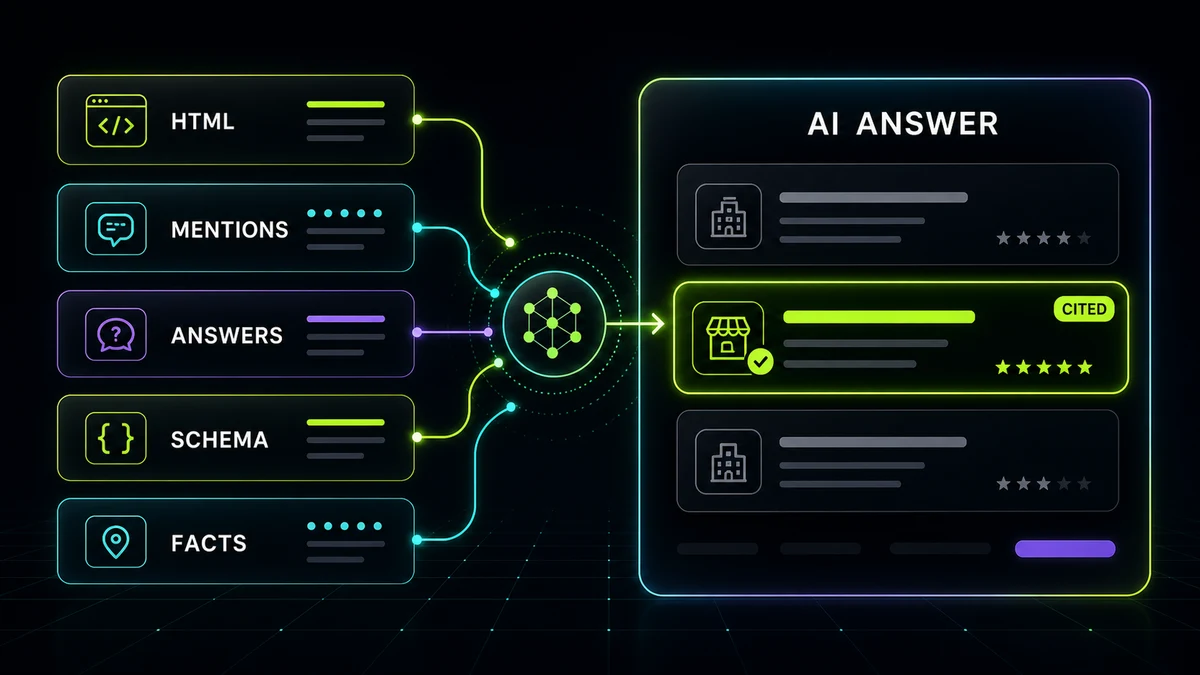
ChatGPT names businesses it has repeatedly seen described in clear, crawlable, trustworthy sources. “Showing up” in ChatGPT means becoming one of those businesses: the handful it recommends by name when someone types “who should I hire for [service].” There’s no ad slot to buy and no form to submit. Whether you call it showing up in ChatGPT or appearing in ChatGPT results, it is the same outcome: the model names you. You earn the mention the way you’d earn a referral: by being legible and well-regarded everywhere the model looks.
That’s good news, because the levers are concrete. Whether ChatGPT cites you comes down to five things: whether its crawler can actually read your site, whether trusted third-party sources mention you, whether your content answers questions directly, whether your structured data spells out who you are, and whether your business details are consistent across the web. This is the practical core of answer engine optimization: getting cited rather than merely ranked.
Below is the five-step playbook, starting with a 60-second test of where you stand today.
The 60-second version
If you read nothing else: ChatGPT recommends businesses that are (1) readable by its crawler, (2) mentioned in sources it already trusts, (3) written to answer real questions, (4) described in structured data, and (5) consistent in name and details across the web. Miss the first one and the other four never get a chance. The rest of this guide is how to check and fix each, in order.
Step 1: See where you stand right now
Before you change anything, find out what ChatGPT says about your market today. Open it, turn on search, and type the question a real buyer would ask: “best [your service] in [your market],” or “who should I hire to [solve the problem you solve].” Read what it names.
You’re looking for one of three outcomes. It names you: you already show up, and the job is to hold and widen that lead. It names your category but not you: the demand is there and competitors are capturing it. Or it names a few specific competitors: those are the businesses the model currently trusts more than yours, and they’re your benchmark.
Run the same query in Perplexity, Claude, and Google’s AI Overviews too, because each pulls from different sources and may name a different set. Our AI Visibility Check runs one buyer-intent question across ChatGPT, Claude, and Gemini and shows you who got cited where. The Gemini result is a proxy for Google AI Overviews; the tool does not check Perplexity or capture an Overview.
Why most businesses don’t show up
Most businesses that aren’t cited share one of three problems, and the first is by far the most common.
The big one is that the crawler can’t read the site. If your pages assemble their content with JavaScript in the browser, ChatGPT’s crawler (OpenAI runs OAI-SearchBot for live search) often receives a near-empty shell, with your services, your copy, and your proof all invisible. We walk through exactly what that looks like in why ChatGPT can’t see your website. The second problem is permissions: a stray rule in your robots.txt can block AI crawlers outright, which is its own quiet failure mode worth auditing on purpose. The third is thinner: your site is readable, but nothing structured tells the model what you do and no third-party source corroborates it, so it’s left with a brand name and not much else.
Can you add your business to ChatGPT directly?
This is worth answering head-on, because it’s the first thing many owners look for: a place to submit or register your business, the way you’d claim a Google Business Profile. It doesn’t exist. There is no form, no directory, no listing service, and no ad placement that gets your business on ChatGPT.
That means anyone selling you a “ChatGPT listing” or promising to “submit your business to AI engines” is selling something that can’t be bought. ChatGPT builds its answers from what its crawler can read on the open web and what trusted sources say about you. So the only way to get your business on ChatGPT is to become the kind of business it finds and trusts when it looks. One related trap: stacking “best in [market]” claims on your own site doesn’t work either, because models weigh what third parties say about you far more than what you say about yourself.
The good news is that this is exactly the fixable part. The five steps below are, in practice, how you get your business on ChatGPT. There is no shortcut version.
The 5 things that actually get you cited
Clearing the diagnostics above gets you readable. These five levers get you cited.
- Be in crawlable HTML. Server-render your important content so it’s present in the initial page response, not built later in the browser. This is the price of entry: nothing else matters if the crawler leaves with an empty page.
- Earn mentions in sources AI already trusts. Models lean on corroboration: industry directories, trade and local press, association listings, legitimate review sites, and relevant community threads. A business described consistently across several independent sources reads as real and recommendable.
- Answer questions directly. Write the way buyers ask. Lead each page with a plain answer to the question it addresses, then support it, the same pattern an answer engine lifts when it composes a response. Brochure copy that opens with a founder’s origin story gets skipped.
- Spell out who you are with structured data. Schema.org markup (
LocalBusiness,Service,FAQPage) turns your page into facts a model can parse without guessing. It’s how you state your name, location, services, and hours in a language built for machines. - Keep your details consistent everywhere. The same business name, address, phone, and service description across your site, your profiles, and every directory. Conflicting details make a model less confident, and less confident means less likely to name you.
The last two reinforce each other: clear structured data plus consistent off-site facts is what lets a model treat you as a known entity rather than a string of text it isn’t sure about.
What about Perplexity, Claude, and Google’s AI?
The instinct is to optimize for each engine separately, but the foundation is shared. Perplexity is citation-first and shows its sources, so it rewards clear structure and corroboration. Claude is conservative about naming names and leans on clean, factual copy. Google’s AI Overviews draw on the same index that powers Search. The surface differs; the underlying requirements (readable pages, trusted mentions, direct answers, structured data) don’t. If you want the fuller distinction between these acronyms and approaches, we break it down in AEO vs GEO vs SEO. Do the foundational work once and you show up across all of them.
How do you appear in ChatGPT results?
The short answer: make your site readable to OAI-SearchBot, get described consistently by sources ChatGPT already trusts, and state your business facts in structured data. ChatGPT with search on assembles its answer from live web results, so appearing in those results means being one of the pages it can read and one of the businesses the sources it reads agree on. There is no separate trick for “results” versus “answers”; the same five levers above decide both. If you want to see the current state before you change anything, the AI Visibility Check shows whether ChatGPT names you for your headline buyer query today.
Where to start this week
Start with Step 1, because it costs nothing and tells you everything: run the query and see whether you’re named. If you’re not, the highest-leverage first move is almost always making sure your content is server-rendered and your robots.txt isn’t blocking the crawlers. Get readable before you get clever.
For an initial check of your site’s AI search readiness, start with the free AI visibility score. If you want help with the findings, Josh reviews your free AI visibility score and discusses your goals by email before deciding whether a full audit is needed to scope the implementation.