The Generative Engine Optimization Checklist: 14 Checks Before You Expect AI to Cite You

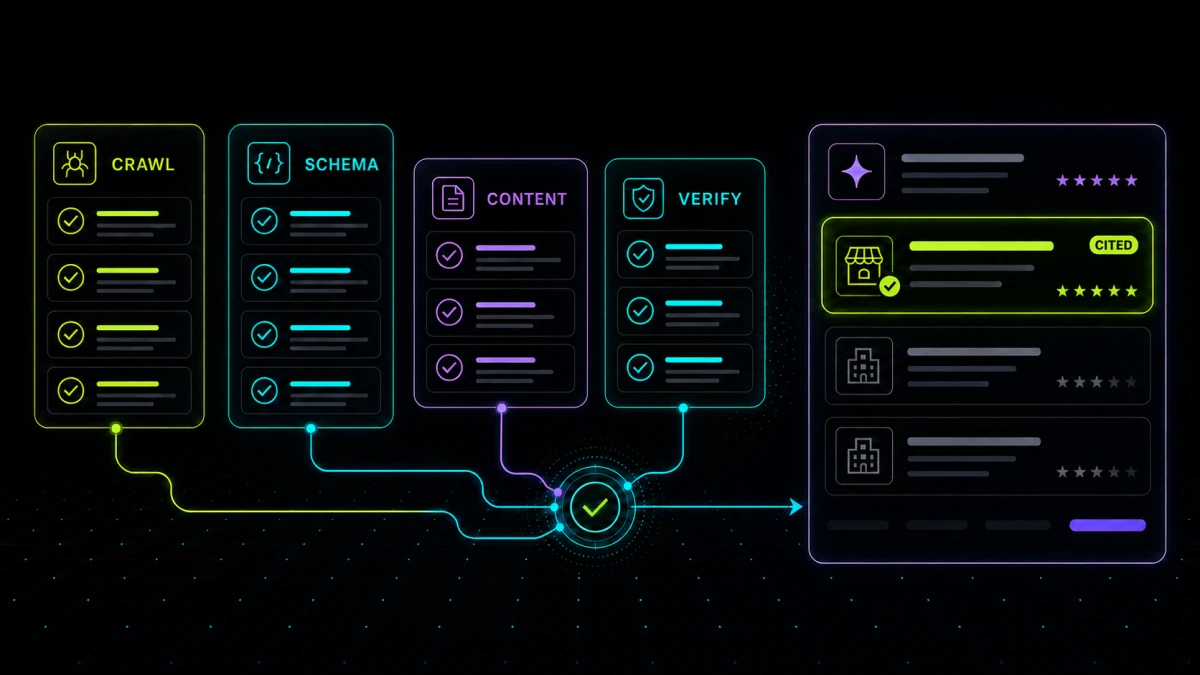
Generative engine optimization (GEO) is the work of making your business citable by AI engines (ChatGPT, Gemini, Claude, Perplexity, and Google’s AI Overviews) when a buyer asks for a recommendation. If you’re untangling the acronyms, we’ve covered AEO vs. GEO vs. SEO separately; the short version is that it’s one program, and the foundation is the same technical work search engines have always rewarded. Even Google’s own guidance on optimizing for its AI features says as much: there’s no secret AI markup, just a site the systems can access, understand, and trust.
Which means GEO is checkable. This checklist covers fourteen checks in four groups: crawlability (can AI engines read your site at all), structured data (do they understand what your business is), content shape (is there anything worth citing), and verification (do they actually name you today). Most checks take under five minutes, and they’re ordered deliberately: a failure early in the list makes everything after it moot.
Crawlability: can AI engines read your site at all?
1. Your content survives View Source. Most AI crawlers read raw HTML and don’t execute JavaScript, so a client-rendered page can look complete to a human and nearly empty to GPTBot. Right-click your homepage, choose View Page Source, and search for a sentence from your main copy. If it isn’t there, start with why ChatGPT can’t see your website, because nothing else on this list matters until this passes.
2. robots.txt allows the crawlers you want. The major AI user-agents all obey robots.txt: GPTBot and OAI-SearchBot (OpenAI’s crawlers), ClaudeBot, PerplexityBot, and Google-Extended. Plenty of sites block them by accident with an old catch-all rule. Paste your file into our robots.txt Analyzer to see exactly which AI crawlers you’re admitting and which you’re turning away.
3. You publish an llms.txt. It’s an emerging standard, not a ranking requirement: a plain-markdown map that tells AI systems what your site is and where the important pages are. It costs minutes with the llms.txt Generator, and our guide to llms.txt and robots.txt covers where to put it and what belongs inside.
4. Nothing important lives only inside JavaScript-driven UI. Testimonial carousels, tabbed panels, and click-to-expand accordions often inject their content at runtime, which leaves it invisible to a crawler that doesn’t run scripts. Same test as check 1: View Source, search for a testimonial. If your proof points aren’t in the HTML, they aren’t in the answer.
Structured data: do AI engines understand what your business is?
5. Organization schema with real sameAs links. AI engines reason about entities, and Organization markup pointing to your actual profiles (Google Business Profile, LinkedIn, industry directories) is how they confirm your business is one coherent, corroborated thing. Run the Entity & Knowledge Graph Check to see how well-defined your entity is right now.
6. LocalBusiness and Service types, properly filled. It takes more than a name and address. areaServed, priceRange, and a Service type per core offering are what let an engine match you to “who does [service] in [area].” The five schema types every service business should have walks through each with paste-ready JSON-LD, and our Schema Generator builds the blocks for you.
7. FAQPage schema on real questions. Question-and-answer pairs are pre-packaged in exactly the shape an answer engine wants to consume. Mark up the questions buyers genuinely ask, not keyword-stuffed filler.
8. All of it validates. Broken JSON-LD is worse than none. Every block goes through Google’s Rich Results Test and the Schema Markup Validator before it ships. Our no-affiliate review of free schema tools covers the full workflow.
Content shape: is there anything worth citing?
9. The first 200 words answer the question. Engines weight openings heavily, and a page that leads with “Welcome to our website” spends its most-quoted real estate saying nothing. State what you do, for whom, and where before the first scroll.
10. Your headers are the questions buyers ask. “How much does [service] cost?” gives an engine a labeled answer to lift. “Our Commitment to Excellence” gives it nothing. Write headers you’d type into ChatGPT.
11. Specifics over adjectives. “Serving the East Valley since 2009, licensed and insured, most projects done in two weeks” is citable. “Trusted, premium, best-in-class” is not. Engines repeat facts, and they can’t repeat a claim with no content. Every superlative you replace with a number improves your odds.
Verification: do the engines actually cite you today?
12. Core Web Vitals pass on mobile. Page experience is part of the same trust calculus, and Google’s Core Web Vitals remain the measurable standard. Run your site through our PageSpeed Impact Calculator, and if mobile is dragging, the mobile Core Web Vitals guide shows which metric to fix first.
13. Ask the engines yourself. Type “who’s the best [your service] in [your market]” into ChatGPT and see who gets named. How to show up in ChatGPT covers the query patterns that reveal citation behavior, and the AI Visibility Check runs the test across engines for you. There’s no substitute for looking.
14. Re-run the list after every meaningful site change. A redesign, a new page builder, or a plugin update can silently reintroduce a failure at check 1, 2, or 8. GEO isn’t a one-time setup; it’s a standard your site either keeps meeting or quietly stops meeting.
Where the checklist becomes a to-do list
Running these checks tells you whether something is wrong. For an initial overview of your site, start with the free AI visibility score. If you want help addressing the findings, Josh reviews your free AI visibility score with you by email and uses a full audit to scope the work once there’s a fit for implementation.