How to Monitor Your AI Visibility (and Catch the Week It Breaks)
If you’ve ever asked ChatGPT “who’s the best [your service] in [your market]” and checked whether your business came up, you ran a citation check. It’s the right first move, and how to get cited by AI covers what earns a spot in that answer. But a citation check is a snapshot, and it expires quietly. The answer you got in March says nothing about July, because two separate things move underneath it: the AI answers themselves, and your own website.
Monitoring is the habit of re-measuring both on a schedule, so a drop shows up in a report instead of in your lead volume. This guide covers why the drift happens, which checks need which cadence, how to run the whole routine manually, and when it’s worth automating.
Why AI answers drift even when your site doesn’t change
AI answers are not reproducible. Ask the same engine the same question twice in one afternoon and you can get differently worded answers naming a slightly different set of businesses. Ask it a month apart and you’re not even asking the same system: the underlying models get updated, the retrieval layer that picks which pages to read gets tuned, and the web the engine searches has changed. None of this is announced. There’s no ranking report to watch, no algorithm-update news cycle like Google SEO has. The answer just changes.
The other side of the drift is your competitors. Readable HTML, structured data, and direct answers are the technical work that earns citations, and it is exactly the work the generative engine optimization checklist walks through. More businesses are doing that work every month. An engine composing an answer picks the easiest-to-verify businesses in the retrieved set. If a competitor ships proper schema in June, the answer that named you in May now has a stronger candidate to name instead. You didn’t do anything wrong. You just stood still in a moving line.
The silent-breakage problem on your own site
The drift you can actually control is the second kind: your site breaking in ways no human visitor notices. These failures are invisible by design, which is what makes them dangerous. The page looks identical in a browser while the machine-facing layer underneath it has changed.
The common ones are mundane. A plugin or platform update rewrites your robots.txt and quietly turns away GPTBot or ClaudeBot. The crawl-access rules that llms.txt and robots.txt covers are one config change away from undone at any time. A theme update drops the JSON-LD block that told engines what your business is. A redesign ships pages that render their content with JavaScript, which reads as blank to most AI crawlers. That is the failure mode behind why ChatGPT can’t see your website. A well-meaning developer adds a catch-all bot rule during a spam incident and forgets to remove it.
Every one of these starts costing you visibility the day it ships, and none of them announces itself. The gap between “it broke” and “somebody noticed” is the expensive part, and without monitoring that gap is measured in weeks.
Two cadences, not one
A useful monitoring habit treats the two kinds of drift differently, because they move at different speeds and cost different amounts to measure.
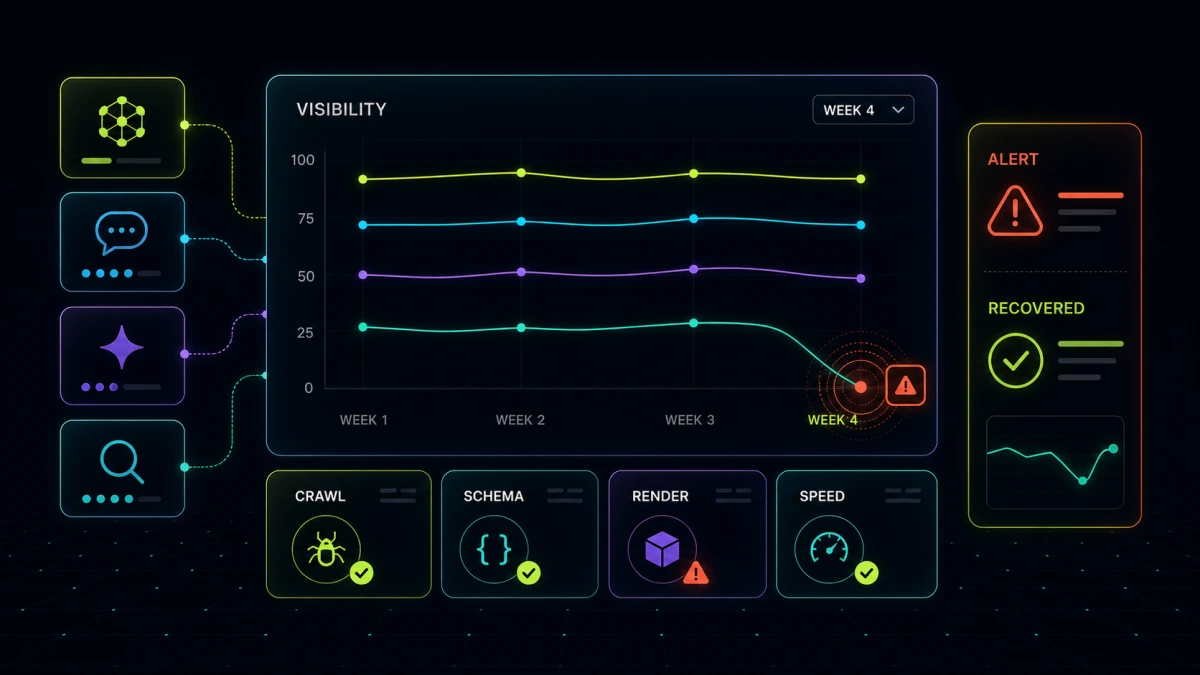
Your technical foundation can and should be checked often. Schema presence, crawler access, an intact llms.txt, server-side rendering, and page speed are all deterministic checks. Each one is free to run, the result is a clear yes or no, and since a regression starts costing you immediately, a daily or weekly cadence is reasonable. This is the smoke detector.
Citation outcomes are worth checking monthly, not daily. Because answers vary run to run, a daily citation check mostly measures noise. You’d see businesses appear and vanish and learn nothing. A monthly check is frequent enough to catch a real trend (you stopped appearing, a new competitor started) while letting the run-to-run variance average out. It also keeps the cost sane if you’re paying for API calls or your own time.
The manual routine
You can do all of this yourself in about twenty minutes a month. Pick three to five buyer-intent queries and ask them on each engine you care about. The questions from how to show up in ChatGPT are the right shape to borrow. Record who got named and whose pages appeared as sources in a spreadsheet, one row per month, so you’re building a trend and not a pile of screenshots. Then re-run the foundation checks: the robots.txt Analyzer for crawler access, the Schema Generator page to validate what’s on your pages, and a speed check. Diff against last month. Anything that changed, investigate.
The honest caveat about the manual routine is that its failure mode is you. Month one happens, month two happens late, month three doesn’t happen, and the quarter your robots.txt broke is the quarter you skipped. The routine is genuinely free; the discipline isn’t.
When to automate
Automation earns its keep in two situations: the manual habit has already lapsed once, or AI-referred customers are worth enough that a multi-week detection gap is a real cost. What automated monitoring should give you is exactly the two cadences above. It runs daily checks on the technical foundation with an alert when something regresses, and a monthly citation re-run so the trend keeps building without you remembering to build it. That’s what the monitoring in Scale Visibility’s audit engine does for the sites Josh looks after, once an audit establishes the baseline: the alert email arrives the day a schema block disappears rather than the month your leads dry up.
Start with the baseline
Whichever way you run it, monitoring needs a starting measurement to compare against. You can’t catch a drop you never measured. Run the full check once, fix what it finds so you’re monitoring a healthy site rather than logging a broken one, and record who AI names for your queries today. For an initial view of your readiness, start with the free AI visibility score. When there’s a fit for implementation or ongoing support, Josh uses a full audit to help establish the baseline and scope the work. From there, watching is cheap. It’s the not-watching that costs.