What Is Answer Engine Optimization (AEO)? A 2026 Field Guide

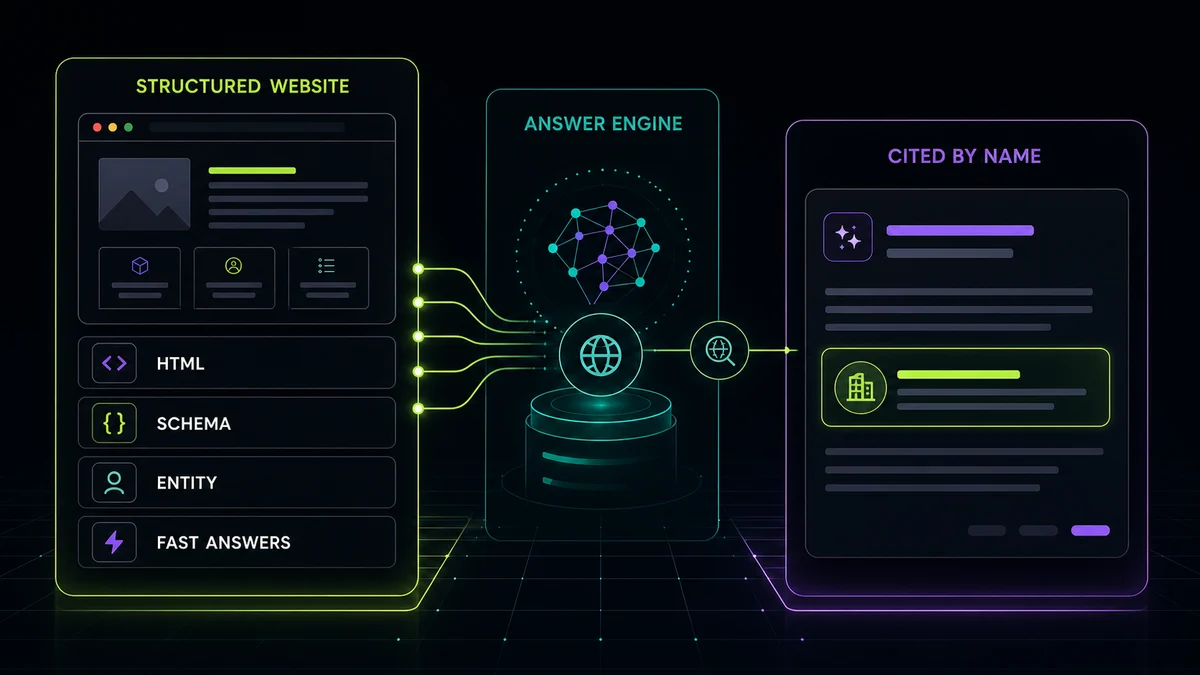
Ask ChatGPT “who’s the best [whatever you do] for [what I need],” and it won’t hand you ten blue links. It names a few businesses. Sometimes one. Whoever gets named wins the customer before a results page ever loads.
Answer engine optimization (AEO) is the work that makes your business one of those names. It’s the practice of structuring your website so AI answer engines (ChatGPT, Claude, Perplexity, and Google’s AI Overviews) can read it, trust it, and cite it when someone asks a buying question in your field.
If that sounds like SEO wearing a new acronym, it half is. The technical foundation overlaps heavily. But the judge changed, and the new judge reads your site very differently from the way Google’s crawler does. This guide covers what an answer engine actually is, how it decides who to cite, and the concrete levers that move the needle, all of it grounded in public documentation, not speculation.
A search engine retrieves. An answer engine answers.
A search engine returns a ranked list and lets you choose. You type a query, you get results, you click. Ten options, and your click is the decision.
An answer engine collapses that. It reads across many sources, synthesizes one response, and, increasingly, names specific businesses inside it. There’s no page of options to scroll. The citation is the result. If your business is the one the model names, you’ve effectively won the top of the funnel; if it isn’t, you’re not on page two, you’re nowhere in that conversation.
That shift from a list to an answer is why AEO exists as its own discipline. The goal is no longer “rank #4 for a keyword.” It’s “be the business the model cites when a buyer describes their problem.”
AEO vs. SEO: same foundation, new judge
The overlap is real, and it’s good news: the engineering work that makes a site fast, crawlable, and well-structured helps you in both Google’s classic results and in answer engines. A site that earns AEO is almost always a stronger site to rebuild around for traditional search too.
The difference is what each judge rewards:
- SEO optimizes for position in a list of links, measured in rankings and clicks.
- AEO optimizes for being cited inside a synthesized answer, measured in whether the model names you at all.
You don’t choose between them. They run on the same technical base. AEO just raises the bar on the parts of that base (readable HTML, clear structure, machine-readable facts) that most websites quietly skip.
How an answer engine decides who to cite
Four things have to be true before a model can name you. Miss any one and you fall out of the answer.
1. It has to be able to read your page. Most AI crawlers fetch your raw HTML and leave. They generally don’t run JavaScript or wait for a page to finish rendering the way a human browser does. If your content only appears after JavaScript executes, the model often sees an empty shell. This is the single most common reason a perfectly good business is invisible to AI, and it’s worth its own read: what AI crawlers actually see on a typical website.
2. It has to understand what you are. Prose is ambiguous to a machine; structured data isn’t. Schema.org is the shared vocabulary that lets you state your facts (what you do, where, your services, your reviews) in a form engines parse without guessing, and Google’s structured data documentation treats it as a first-class signal. You can generate paste-ready markup with our free schema markup generator.
3. It has to trust you as an entity. Answer engines reason over knowledge graphs: networks of entities and the facts that link them. The clearer and more consistent your business is as a defined entity (name, profiles, topics you’re known for), the more confidently a model will name you instead of hedging. Our entity & knowledge graph check scores exactly those signals.
4. It has to find the answer stated plainly, fast. Models weight the top of a page heavily and reward copy that answers the question directly. Brochure hero copy and founder bios buried above the substance cost you citations. A clear, concise opening keeps you in the running, and so does a fast-loading page, since speed affects whether crawlers extract your content at all.
The practical levers
AEO isn’t a mystery once you know what the engines need. The moves that matter:
- Serve real HTML. Render your content on the server so it exists in the page a crawler downloads, not only after a script runs.
- Add structured data for your organization, services, and FAQs (start here).
- Tell crawlers what to read. A clean llms.txt file points models at your important pages, and your robots.txt should actually allow the AI crawlers you want citing you. Many sites block GPTBot and others by accident.
- Write the answer first. Lead each key page with a direct, quotable response to the question it targets.
- Then check whether it’s working with our AI visibility check, which asks the major engines buyer-intent questions and shows whether they name you.
AEO, GEO, LLMO: mostly the same thing
You’ll see the work called generative engine optimization (GEO) and large language model optimization (LLMO) too. The acronyms multiply faster than the substance: they all describe getting cited by AI, and they all rest on the same foundation above. The differences are real but narrow, and they’re worth a post of their own rather than a footnote here.
How to find out where you stand
The fastest way to see AEO in action is to run the test on yourself. Open ChatGPT and ask it to recommend the best provider in your field and city, and watch whether your name comes up. If it doesn’t, or your category does but you don’t, that’s the gap AEO closes.
For an initial overview of your site’s AI search readiness, start with the free AI visibility score. A full audit helps scope the fixes when there’s a fit for implementation work with Josh. Getting found in AI search starts with knowing where you actually stand.