How to Improve Your AI Search Visibility: The Four Places Assistants Look

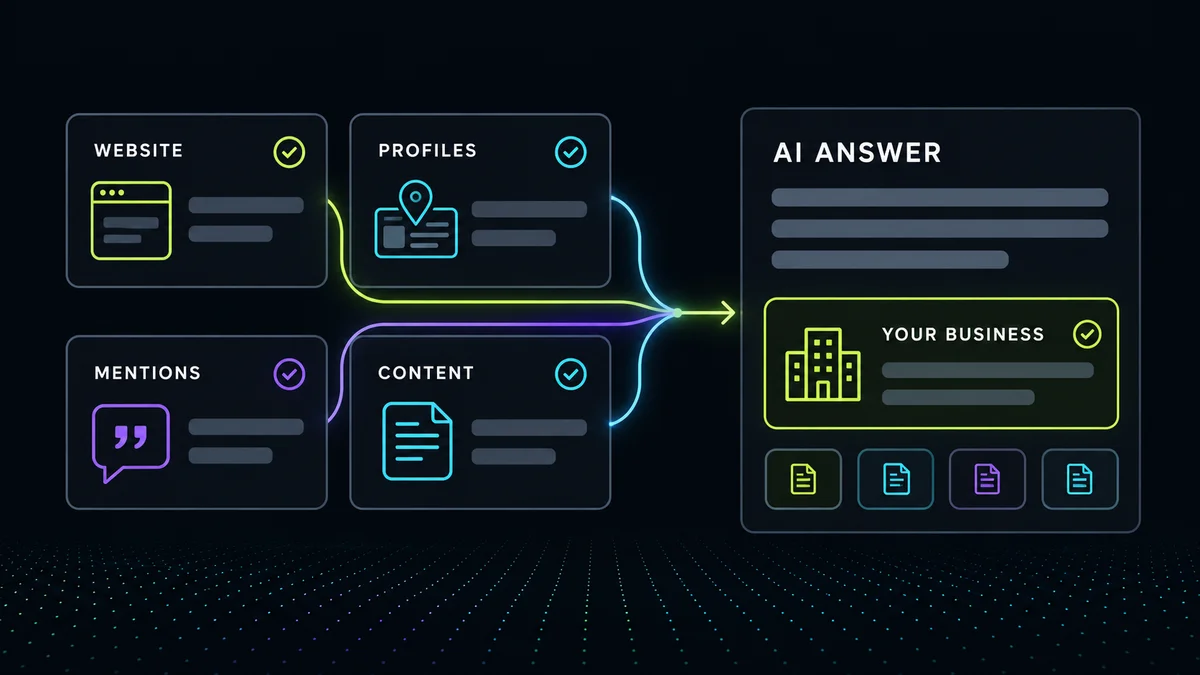
AI search visibility is whether ChatGPT, Claude, Gemini, and Perplexity name your business when someone asks them who to hire, and whether what they say about you is right. It is not a ranking. For any one question, an assistant either includes you in its answer or it does not, and when it includes you it describes you in a sentence or two assembled from whatever it could find.
Most advice on improving it treats the problem as a website problem. Add schema, fix rendering, publish a file for crawlers. That work matters and it comes first, but it is one of four places assistants read. When an assistant answers “which firms should we shortlist for commercial HVAC maintenance across twelve locations,” it draws on your site, your business profiles and listings, what other sites say about you, and whether you have published anything that answers the question. A business can have a technically clean site and still be invisible because the other three are thin, or be named for the wrong services because a directory has them wrong.
This post walks through the four places, what improves each one, and how to tell which one is holding you back.
Where do AI assistants get what they know about a business?
Assistants no longer answer from memory alone. ChatGPT search, Perplexity, Gemini, and Claude all retrieve live web pages for a question like this and write the answer from what those pages say, a process Google’s guide to generative AI features calls grounding. OpenAI runs a separate crawler for it, OAI-SearchBot, whose only job is to surface sites in ChatGPT’s search answers. How to get cited by AI covers what those retrievers look for in a single page.
What gets retrieved for a “who should I hire” question is rarely one page. It is your site, a business profile, a directory listing, a review platform, a news mention, a roundup, and a forum thread where a stranger asked the same thing. The assistant reconciles those into one answer. Where they agree, it speaks confidently. Where they disagree, it hedges or picks one, and the one it picks is not always yours. That is why the work splits into four areas.
1. Your website: can assistants read it, and does it state the facts plainly?
The site is the source you control completely, so it goes first. Three things have to be true. The crawlers have to be allowed in, which means robots.txt does not block GPTBot, OAI-SearchBot, ClaudeBot, PerplexityBot, or Googlebot, and neither does the CDN or firewall in front of the site. The content has to exist as HTML text rather than be painted in by JavaScript after the page loads, the problem why ChatGPT can’t see your website explains. And the basic facts, the legal name, what you do, where you serve, how to reach you, have to appear as plain text and again in structured data. The five schema types every service business should have cover it, and the schema generator writes the JSON-LD.
An llms.txt file gives the engines that read it a curated index of your best pages, and page speed still counts. The generative engine optimization checklist has the full fourteen checks with a free tool for each, and the free AI visibility score runs them against a domain in seconds.
2. Profiles and listings: do the facts agree everywhere?
Assistants treat business profiles and directories as fact sources, because that is what they are built to be. Google says so directly. Its generative AI guide notes that AI responses can include information about local businesses and says a Business Profile can help a business be visible in those responses, and its local ranking documentation names relevance, distance, and prominence as the factors, with prominence built partly from reviews and from how many sites link to the business.
The work here is consistency, and the list of places depends on the business. For a company with physical locations it is Google Business Profile, Apple Business Connect, Bing Places, and the directories that matter in the industry. For a national or B2B company it is LinkedIn, the industry associations, the trade directories, and the data aggregators the others feed from, and a Google Business Profile may not apply at all. Whatever the list is, name, address, phone, hours, and services should read the same in each place, every entry should agree with the site, and the site should link to them with the sameAs property so an assistant can confirm they describe the same company. Entity SEO explains why this matters more than it used to, and the entity check shows which of your signals disagree.
A quick test tells you where you stand. Ask an assistant to tell you about your business by name. If it gets the services, the location, or the phone number wrong, some listing somewhere says so, and that listing is the fix.
3. Mentions on other sites: who vouches for you?
When two businesses both have clean sites and accurate profiles, the one assistants name is usually the one other sites talk about. Reviews, a news feature, an industry association listing, a quote in a trade publication, an honest “best of” roundup, a forum thread where a customer recommended you. These are the sources an assistant leans on when it decides who belongs in the answer, because they are evidence that someone other than you thinks you are good.
They have to be real. Google’s guide is blunt that seeking inauthentic mentions is not as helpful as it sounds, because the same systems that block spam in search results govern its AI features. Bought links, planted forum posts, and paid reviews earn nothing. What works is slower. Publish original data or a point of view an industry writer would want to quote. Give a reporter who covers your industry a real story. Get listed where your industry lists its members. Ask real customers for reviews once the work is done. When a roundup in your category leaves you out, find out who wrote it and give them a concrete reason to add you. This is the area most businesses never work, which is why it separates the ones assistants name from the ones they skip.
4. Content: do you answer the questions buyers ask before they hire?
Assistants cite pages that answer specific questions, and buyers ask a lot of them before they ask who to hire. What a project like theirs usually costs. How long it takes. What the process looks like. What goes wrong when it is done badly. A services page that lists everything you do is a poor match for any of those. A page that answers one of them in the first paragraph, with the details below, is the kind of page an assistant lifts from, and the business it lifts from is the one it names. How to appear in Google AI Overviews explains how Google’s systems fan a question out into sub-questions and pull a page for each.
The bar for that content is accuracy, not volume. Put a named author on it with real credentials, keep the facts current, and say what you actually know. Pages generated to fill a slot are what Google’s spam policies target, and the guide says its AI features depend on those same systems. Three pages a year from someone who does the work beat thirty from someone who does not.
Which area should you fix first?
Diagnose before you build. Run the AI Visibility Check with the question a buyer would ask and see which businesses ChatGPT, Claude, and Gemini name. Then ask each one to describe your business. The pattern tells you where the gap is.
If the assistants cannot describe your business at all, or describe a stale version of it, start with the site. If they describe it wrong, start with the profiles and listings, because that is where wrong facts usually live. If they describe you correctly but name competitors instead, look at what those competitors have that you do not, which is nearly always mentions and reviews. If they name you for your own name but never for a buyer’s question, the missing piece is content that answers those questions.
In practice the order is the site first because everything else points to it, profiles second because they are cheap to fix, and then mentions and content together, month after month, because both compound and neither is quick.
How do you know it is working?
Check the same way every month. Ask the same buyer questions across the same assistants, record who is named and what is said, and compare it to the month before. For Google, the Search Console Generative AI performance report shows the impressions your pages earn inside AI Overviews and AI Mode. How to monitor your AI visibility lays out the routine. Expect uneven movement, since answers change as sources change and a business can appear in one assistant’s answer months before another’s.
None of this guarantees a mention. What it does is build the foundation assistants need to find you, verify you, and describe you correctly, which is the condition every mention depends on. For a first look at where your site stands, run the free AI visibility score. If you want one person to work all four areas and report each month on what the assistants say, that is what the service covers, and the place to start is a conversation with Josh.