AI SEO: What It Actually Means (and Where to Start)

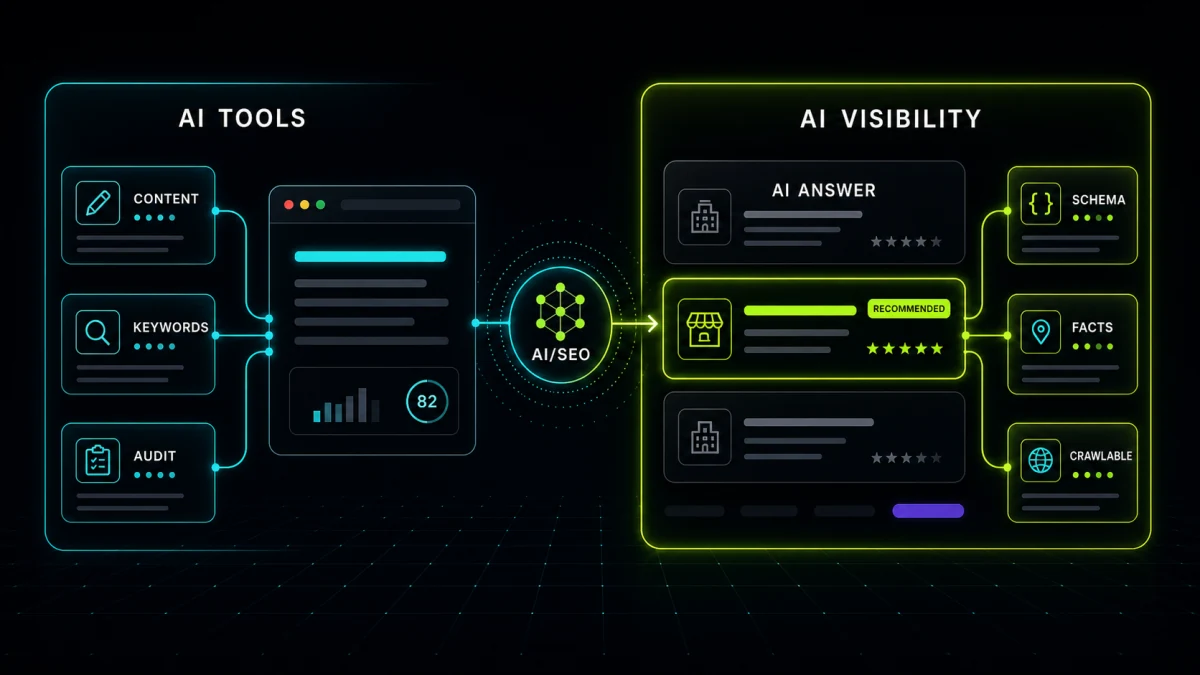
AI SEO means two completely different things depending on who is writing about it, and the difference matters to anyone who wants customers out of it. The first meaning is using AI tools to do the SEO work itself. You point software at your site and it generates the content, researches the keywords, and runs the audits faster than you could by hand. The second meaning is optimizing your website so that AI engines like ChatGPT, Gemini, and Perplexity can find it, understand it, and recommend your business when a potential customer asks for what you do. Most articles ranking for “AI SEO” cover the first meaning. This guide covers the second, because that is the one that determines whether a buyer who asks ChatGPT which firms to shortlist for what you do ever hears your name.
The distinction is not academic. A tool that writes blog posts faster does nothing for a site AI crawlers cannot read. And a site AI engines can read, verify, and confidently cite will surface in answers whether or not any AI tool touched its content. For most businesses, the second kind of AI SEO is the higher-leverage work, and most of it is technical, one-time, and cheap.
The two meanings, side by side
AI-assisted SEO is a workflow question. The tools speed up keyword research, draft content, and flag technical issues, which changes how fast you produce SEO work. It does not change whether AI engines can see the result. If you want a starting point for that side, Google’s own guidance on succeeding in AI search is more grounded than most tool marketing. Write unique content, give people a good page experience, and make sure the page can actually be accessed. Nothing exotic.
AI visibility SEO is the work this site calls answer engine optimization. The goal is to become one of the handful of businesses an AI engine names when a buyer asks a question in your category. AI answers do not show ten blue links. They name two or three businesses inside a sentence. Either you are in that sentence or you are invisible for that query.
When a business owner or a marketing lead searches “AI SEO,” they usually want the second thing, even if the results serve them the first. The rest of this guide is the second thing.
Why this is still an open field
Traditional SEO rewards accumulated authority. Years of published content, a backlink profile built over time, and domain history all compound, and that race structurally favors incumbents. AI visibility work is different in a way that favors you. An engine composing an answer needs facts about your business that it can read and verify, starting with what you actually do, where you operate, what you charge, and who is willing to vouch for you. Most competitors in most categories have never stated any of that in a form a machine can use. Their sites carry the same brochure copy and the same empty markup yours probably does. The first business in a category to do the technical work clearly is competing in something close to an empty field.
This is the same reason entity SEO is worth doing before anything else. The work is definitional rather than budget-driven. You do not out-spend anyone here. You out-declare them.
The five-part starter plan
1. Make sure AI can read your site at all. Major AI crawlers do not execute JavaScript, so any content that only appears after scripts run is invisible to them. This single issue is why ChatGPT cannot see many websites. Check your robots.txt while you are in there. Overzealous rules routinely block crawlers like OpenAI’s GPTBot and OAI-SearchBot without the site owner ever knowing they are there.
2. Add the schema that declares what you are. Structured data is how you state your business category, service area, hours, and pricing in a form engines trust. Google’s structured data documentation is explicit that markup helps systems understand pages rather than guess. Start with the five schema types every service business should have, and generate paste-ready blocks with the free Schema Generator.
3. Make your business a consistent entity. Same name, address, phone, and category language on your site, your business profiles, and every directory that mentions you, tied together with sameAs links. Run the Entity Check to see how well-defined your business looks to a machine today.
4. Write pages that answer questions. AI engines lift concise, direct answers. A services page that opens with what you do, where, and for how much beats a hero section of adjectives. If you want the fuller working list, the generative engine optimization checklist covers all fourteen checks in one place.
5. Test it, then keep an eye on it. Ask the engines your customers’ questions and see who gets named. The AI Visibility Check runs buyer-style queries for you, and how to show up in ChatGPT walks through what to do with the result. Answers drift over time, so a periodic re-check matters more than a one-time snapshot; monitoring your AI visibility covers the habit.
So should you ignore AI tools entirely?
No. Use them for what they are genuinely good at, which is drafting, summarizing, and cutting the time research takes. Just be clear about what they cannot do. No content tool fixes a site that crawlers cannot render, and no volume of AI-generated blog posts substitutes for the structured, verifiable facts an engine needs before it will name a business in an answer. Foundation first, production second.
Where to start
You do not have to guess which of the five areas is your weak one. The free AI visibility score checks your site the way an AI engine sees it and shows you where you stand in a few minutes. Run it, fix the gaps it surfaces, and you will have done more real AI SEO than a year of tool subscriptions.