AEO vs GEO vs SEO: What Actually Matters (and What's Just Hype)

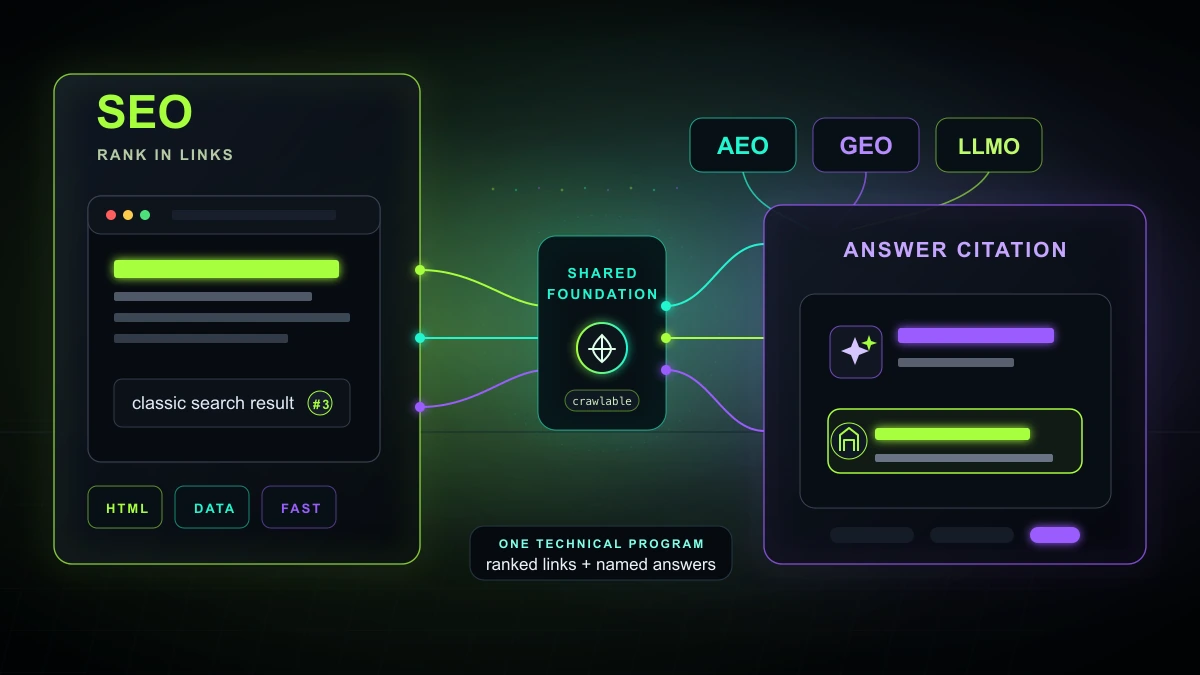
Four acronyms are competing for your attention in 2026: SEO, AEO, GEO, and LLMO. Most articles comparing them spend their length arguing over definitions. This one won’t. Here’s what each actually means, what’s genuinely new, and which “GEO tactics” are just old SEO advice wearing a new label.
The short version: AEO, GEO, and LLMO are three names for the same shift, from ranking in a list of links to being named in an answer. SEO is the older discipline all three build on. If you understand that, you understand 90% of the debate.
The four acronyms, defined plainly
- SEO: Search Engine Optimization. Getting your pages to rank in the classic list of blue links on Google or Bing. Decades old, well understood, still matters.
- AEO: Answer Engine Optimization. Getting cited when an answer engine (ChatGPT, Claude, Perplexity, or Google’s AI Overviews) responds to a question directly instead of returning a list. We covered the full picture in what answer engine optimization actually is.
- GEO: Generative Engine Optimization. Optimizing to be referenced by generative AI. In practice this is the same work as AEO; the two terms are used interchangeably, with “GEO” slightly favored in academic and enterprise circles.
- LLMO: Large Language Model Optimization. Same idea again, framed around the model rather than the “engine.” Not meaningfully different from GEO.
So three of the four (AEO, GEO, LLMO) describe one thing. The useful distinction is just SEO vs. everything-else: ranking vs. getting cited.
What’s the same across all of them
Here’s the part the acronym wars obscure: the technical foundation is shared. A site that Google can’t crawl and AI can’t read fails at all of them simultaneously. The same engineering work pays off across the board:
- Readable, server-rendered HTML: if your content only appears after JavaScript runs, both Google’s deeper crawls and AI crawlers can miss it. (This is the single most common failure; it’s why ChatGPT often can’t see a perfectly good website.)
- Structured data: Schema.org markup that states your facts unambiguously, which both Google’s rich results and AI citations lean on. The five schemas every service business should have is the practical starting point.
- Speed and clean structure: fast pages with clear hierarchy get crawled more fully and extracted more reliably.
Build that foundation once and you’re competing in classic search and AI answers. That’s why framing these as rival disciplines you have to choose between is misleading.
What’s genuinely new (the 30% that matters)
Strip away the rebranding and a handful of things really are different in the AI-answer era:
- The unit of success changed. SEO optimizes for a position in a list. AEO/GEO optimizes for being named inside a synthesized answer, often the only answer the user sees. There’s no “page two” to settle for.
- Entity clarity matters more than keywords. Answer engines reason over knowledge graphs: networks of entities and facts. Being a clearly-defined entity (consistent name, profiles, topics you’re known for) now competes with traditional keyword targeting for influence over whether a model names you confidently or hedges.
- Concise, quotable copy wins. Models weight the top of a page heavily and lift direct answers verbatim. Brochure hero copy that buries the substance costs citations in a way it never cost rankings.
- New access controls exist. llms.txt and AI-specific robots.txt rules let you guide AI crawlers explicitly, a lever that simply didn’t exist in the classic SEO playbook.
What’s just SEO with a new coat of paint
Most “GEO tactics” floating around are recycled fundamentals. If an article sells you these as new, it’s padding:
- “Write quality content that answers user questions.” (That’s been SEO advice since 2011.)
- “Earn authoritative backlinks and mentions.” (Trust signals, unchanged.)
- “Improve page speed and mobile experience.” (Core Web Vitals, already a Google ranking factor.)
- “Use clear headings and logical structure.” (On-page SEO 101.)
- “Keep your information accurate and current.” (Always was the job.)
- “Build topical depth around your expertise.” (Topic clusters, a decade old.)
None of these are wrong. They’re just not new, and you were supposed to be doing them already.
Which one should you actually care about?
You don’t pick. It’s one program, not three. The mistake is treating AEO/GEO as a separate initiative you bolt on after SEO, or, worse, choosing between them. The reality:
- The foundation (rendering, schema, speed, structure) serves all of them at once.
- The genuinely-new AEO layer (entity clarity, concise answers, crawler access) is a thin set of additions on top of that foundation, not a parallel discipline.
- Classic SEO still drives the searches that haven’t moved to AI answers, which is most of them, for now.
So the right framing isn’t “should I do SEO or GEO.” It’s: build the technical foundation that serves both, then add the handful of AI-specific touches that tilt answer engines toward citing you.
How to see where you stand
The fastest gut check: open ChatGPT and ask it to recommend the best provider in your field and city. If your category gets named but you don’t, you have an AEO gap, and it almost always traces back to the shared foundation above, not to some exotic “GEO secret.”
For an initial look at your site’s AI search readiness, start with the free AI visibility score. A full audit helps scope the work when there’s a fit for implementation with Josh. The acronyms will keep multiplying; the underlying work won’t change nearly as fast.