Free Schema Markup Generators That Actually Work (a No-Affiliate Review)

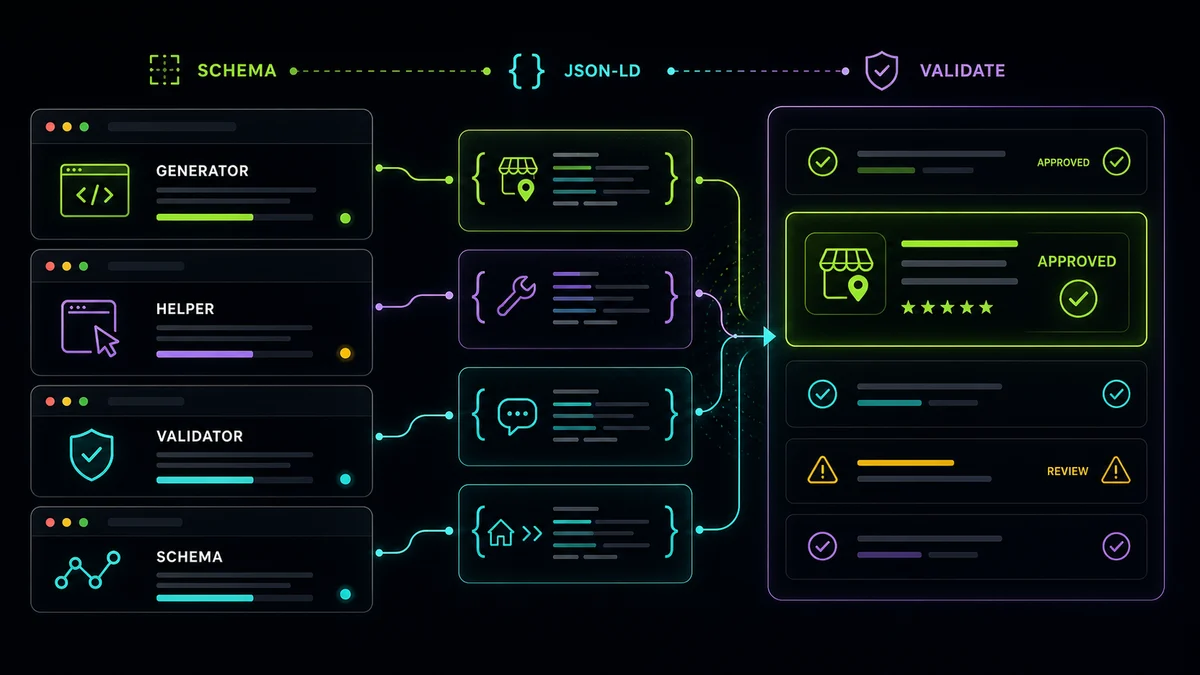
Search “free schema markup generator” and most of what comes back is affiliate roundups: fifteen tools, five stars each, and a commission link under every button. This is the other kind of review. We write structured data for service-business sites every week, we take no affiliate money, and one of the tools below is ours, included on merit, with its limitations stated as plainly as everyone else’s.
The short version: you only need about three tools, and all of them are genuinely free. TechnicalSEO.com’s Schema Markup Generator is the best general-purpose pick. Our own Schema Generator is the right one for local and service businesses optimizing for AI search specifically. And Google’s Rich Results Test plus the official Schema Markup Validator are the non-negotiable checking step before anything goes live. Google’s Structured Data Markup Helper, the tool older roundups still list first, is the one to skip for production work.
Here’s what separates a good generator from a bad one, the honest shortlist, and the one gap every tool on this list shares.
What makes a schema generator actually good
Schema markup is structured data written in the Schema.org vocabulary, and the format that matters is JSON-LD, the format Google explicitly recommends: a self-contained script block that states facts about your business without touching the surrounding HTML. Three things separate a generator worth using from one that wastes your afternoon:
- It outputs clean JSON-LD, not microdata. Microdata-era tools weave attributes through your HTML, which breaks the moment you redesign. JSON-LD lives in one block you can move between pages, templates, and site rebuilds.
- Its type list is current. Schema types aren’t static. Google dropped support for seven structured-data types in mid-2025 as part of simplifying its results page. A generator still steering you toward retired rich-result types is spending your effort where nothing reads it. (The flip side: AI assistants now read schema for citation decisions, not just rich results, so types like
ServiceandFAQPagematter beyond what Google renders.) - No lock-in. The output should be code you own and paste yourself. Email gates, signup walls, and tools that “install” your schema through their own JavaScript snippet are all red flags, the last one doubly so, because schema injected client-side may never be seen by AI crawlers at all.
The honest shortlist
TechnicalSEO.com Schema Markup Generator: the general-purpose workhorse
The TechnicalSEO.com generator (built by Merkle, now under Dentsu) has been the default recommendation for years, and it earns it: thirteen types including Article, Event, Job Posting, Product, Recipe, Video, and Local Business, clean JSON-LD output, required properties included, no signup. If you need a type our tool doesn’t cover, this is where to go.
Honest weaknesses: it’s general-purpose, so it fills exactly the fields you give it and no more. It won’t nudge you toward the properties that matter for AI-search citation, like areaServed geometry on a LocalBusiness or sameAs links on an Organization. And parts of it are showing age: it still links out to Google’s long-retired Structured Data Testing Tool as a validation step. Generate here, but validate with the current tools below.
Google’s Structured Data Markup Helper: skip it for production
Google’s Markup Helper is still online, and it has one real use: the tag-the-page workflow (highlight an element, assign it a property) is a decent way to learn how markup maps to visible page content. But the tool is a time capsule. Its type list (Book Reviews, TV Episodes, Restaurants) reflects the rich-snippet era it was built in, not what search engines or AI assistants read today. Older roundups list it first because it’s Google’s; that’s brand trust, not utility. Learn from it if you like, but don’t build production markup with it.
Our Schema Generator: built for the AI-search use case
Our free Schema Generator exists because the general-purpose tools weren’t built for the question service businesses are actually asking in 2026: what markup makes an AI assistant confident enough to cite me? It generates paste-ready JSON-LD for the four highest-impact types for that job: LocalBusiness, Organization, Service, and FAQPage. Each type comes with a note on how AI assistants actually use it. No signup, no email gate, and the output is plain JSON-LD you own.
Honest limitations: it covers four types, not thirteen. If you need Product, Recipe, or Event markup, use TechnicalSEO.com’s. It handles one page at a time, like every other tool here. And for Organization markup specifically, our Entity & Knowledge Graph Check goes deeper: it audits how well-defined your business entity already is and generates the schema to fix what’s missing.
The validators: the half of the workflow people skip
A generator’s output is a draft until it’s validated. Two free tools, different jobs: the Rich Results Test tells you whether Google can read your markup and which rich results it’s eligible for, and the Schema Markup Validator checks your JSON-LD against the full Schema.org vocabulary, including the types Google doesn’t render but AI assistants still read. Run both. Thirty seconds each, and they catch the trailing-comma and wrong-nesting errors that silently invalidate an entire block.
Which tool for which job
- Local or service business, optimizing for AI search → our Schema Generator, then the deeper walkthrough in the 5 schema types every service business should have
- Product, Recipe, Event, Article, or Video markup → TechnicalSEO.com
- Understanding how markup maps to a page → Google’s Markup Helper, as a classroom only
- Checking anything before it ships → Rich Results Test + validator.schema.org
- Defining your business entity for knowledge graphs → the Entity & Knowledge Graph Check
The gap every one of these tools shares
Every tool in this review, ours included, works one page at a time. None of them can tell you which pages across your site are missing schema, whether the markup on your service pages contradicts the markup on your homepage, or whether your schema is even reachable by the crawlers that matter, because markup rendered client-side by JavaScript is invisible to most AI crawlers, the same root cause that hides whole sites from ChatGPT.
For help implementing schema across your site, see the AI visibility service. Josh starts with your free AI visibility score, then uses a full audit to identify the gaps and scope the work when there’s a fit. The free score on that page is a place to start checking your readiness yourself.