The Best AI Visibility Tools for Service Businesses (An Honest 2026 Comparison)

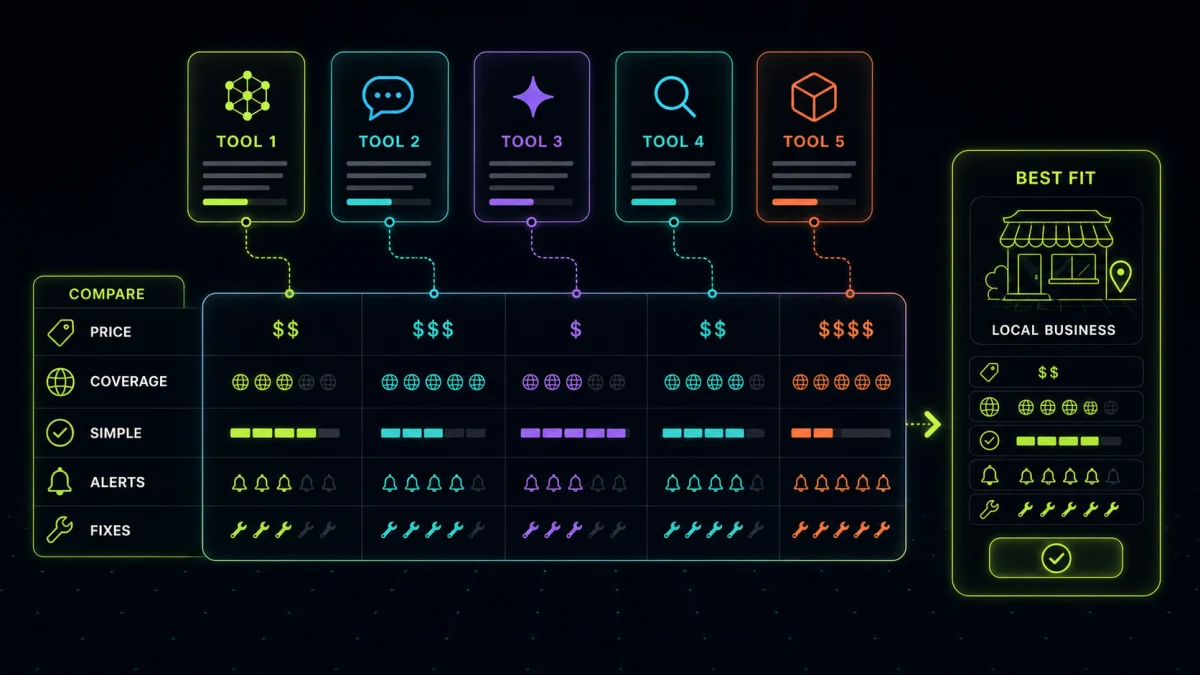
Buyers have started asking ChatGPT, Gemini, and Perplexity the question they used to type into Google: “who should we hire for [service]?” A whole tool category has sprung up to answer the question that follows: does AI name my business or not? And it’s growing fast.
Here’s the problem: almost all of it is built for in-house SEO teams. Prompt libraries to curate, credit budgets to manage, dashboards someone is supposed to check every week. If you run a logistics company, a regional healthcare group, or a professional services firm, that someone is usually already doing three other jobs.
This is a comparison of the category from a service business’s point of view. One disclosure up front: we run one of these, the free score at the end. We’ve put it last, we’ve been specific about its limits, and where a competitor is the better pick for you, we say so.
What these tools actually do
Every tool here works the same way underneath: it runs real queries against AI engines on a schedule and records what comes back. It measures two things. A mention means the AI names your business in its answer; a citation means the AI uses your website as a source. Both matter. A buyer who hears three competitor names and not yours never knew you existed, and that’s decided by things you can actually fix.
What matters when you’re not an SEO team
Four criteria drove this comparison, and they’re different from the ones an agency would use:
- A price you can justify against what you’ll do with it. A $200/month dashboard is fine if someone acts on it weekly and a waste if it gets opened once a quarter.
- No prompt engineering. You shouldn’t need to invent and curate a library of test queries. The right queries are obvious from what you do and where: “which firms handle temperature-controlled freight in the Midwest.”
- Alerts, not dashboards. A dashboard assumes someone checks it. An email that says “your schema markup disappeared” assumes nothing.
- Answers that come with fixes. Knowing you’re invisible is step one. Knowing why, and what to paste where, is what changes it.
Prices below are current as of October 2026 and worth re-checking; this category moves fast.
LLMrefs: the best free starting point
LLMrefs has something rare in this category: you can create an account and start tracking without a credit card, across every major engine, meaning ChatGPT, Gemini, AI Overviews, Perplexity, Claude, and Copilot. The paid plan is a flat $79/month for 500 prompts with no per-engine fees, currently flagged as a limited-time price.
Honest read: the free tier is the best zero-cost way to see the category work with your own business name in it. The paid tier’s 500 prompts is far more than most service businesses will ever use. You’d be paying for capacity built for marketers.
Pick it if: you want to poke at AI visibility tracking without spending anything.
Rankscale: cheapest entry, but only if you pay yearly
Rankscale’s cheapest plan is Essentials at $17/month, billed annually, and annual is the only way to buy it. If you want to pay month to month, the entry plan is Pro at $99/month. Essentials no longer appears among the main plans on the pricing page; it’s in the comparison table lower down. Either way it covers an enormous engine list (17+, including Grok, DeepSeek, and Mistral). The trade-off is that it’s credit-based, meaning each query burns credits and you manage the budget yourself. The product is also clearly built for SEO practitioners who live in this kind of tooling.
Honest read: still the lowest monthly price here if you commit to a year up front and you’re comfortable doing the setup and interpretation yourself. If you want to pay monthly, it’s the most expensive entry point in this comparison, not the cheapest.
Pick it if: you (or someone who helps you) already speak SEO, want maximum engine coverage per dollar, and will prepay a year.
Otterly.AI: the simplest budget tracker
Otterly’s Lite plan is $29/month for 15 tracked prompts with brand-mention monitoring across ChatGPT, AI Overviews, Perplexity, and Copilot (Claude and Gemini are paid add-ons), and it’s probably the simplest pure tracker on this list. One caution: the next tier up jumps to $189/month, so if 15 prompts stops being enough, the price quadruples.
Honest read: 15 prompts is a reasonable fit for a business with a handful of core services. Five buyer questions across three markets covers a lot of ground. The cliff to $189 only matters if you grow into it.
Pick it if: you want an ongoing tracker at the lowest simple monthly price and you’ll check it yourself.
Peec AI: built for marketing teams
Peec starts at €85/month (about $96) for 50 prompts tracked daily with competitor benchmarking and unlimited team seats. It’s priced in euros, and the Starter plan covers three AI models; adding a fourth is €25/month more. It’s a strong, focused product, and nearly everything about it (daily granularity, team seats, multi-project plans) is shaped for an in-house marketing function or an agency.
Honest read: nothing wrong with it; it’s just sized for a team that will work it daily. Daily tracking of 50 prompts is a lot of signal if one person owns marketing alongside everything else.
Pick it if: you have a marketing team, or an agency runs your marketing and wants shared access.
Scale Visibility: ours, and not a tool you run
Ours works differently, because it is not a subscription dashboard. You start with a free AI visibility score. Paste your URL, get a technical readiness score in about a minute, and a citation check starts automatically: one buyer-shaped query across ChatGPT, Claude, Gemini, and Perplexity, showing whether any of them name you. If the app cannot confidently identify your business details, it asks you to enter them so the check can run.
Past the score, the tracking is part of a service rather than a product. When there is a fit, Josh runs the full audit (five buyer-shaped queries across all four surfaces, share of voice against your named competitors, the accuracy of what each assistant says about you, and every technical fix), and the monthly AI visibility service re-runs those checks every month and reports what ChatGPT, Claude, Gemini, and Perplexity say about the business alongside the work done on the site, your listings, earned mentions, and content.
Honest limits: we track four surfaces, not seventeen. There are no prompt libraries or credit systems. Queries derive from your services and markets, which is the point, but if you want to track 200 custom prompts, the tools above do that and we don’t. And there is no self-serve plan past the free score. The monitoring comes with one person doing the work, so if all you want is a tracker, pick one of the four above.
Pick it if: you want the answer and the work done, with the tracking as a byproduct of the service rather than a tool you operate.
Side by side
| Tool | Entry price | Free option | Built for |
|---|---|---|---|
| LLMrefs | $79/mo flat (limited-time price) | Yes (free account, all engines) | Marketers testing the waters |
| Rankscale | $17/mo yearly-only, or $99/mo monthly (credits) | Trial | SEO practitioners |
| Otterly.AI | $29/mo (15 prompts) | Trial | DIY brand tracking |
| Peec AI | €85/mo ≈ $96 (50 prompts, 3 models) | Trial | Marketing teams & agencies |
| Scale Visibility | Free score, then a monthly service quoted per scope | Yes (free instant score) | Businesses that want the work done, with tracking included |
The short version
Want to explore for free? LLMrefs. Cheapest ongoing tracking, technical, and happy to prepay a year? Rankscale. Paying monthly, or want the simplest tracker? Otterly. Have a marketing team? Peec. Want the diagnosis, the work done, and a monthly report on what the assistants say, without running the tooling yourself? Start with the free score.
Whichever you choose, do the measuring before the optimizing. Most businesses guessing at how to show up in ChatGPT skip the step where they find out whether they already do. And monitoring over time is what turns a one-time check into an early-warning system.